Lighthouse Coalition India Immersion Trip, August 2026
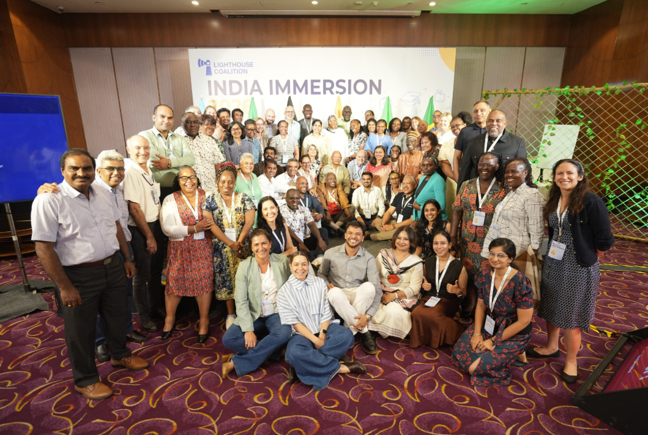
Wow. What an experience.
The brilliant Central Square Foundation (CSF) representative on our bus, Tushar, explained that, in India, the guest is like a god. And I think we can all vouch for that. The warmth and generosity with which we have been received has been almost overwhelming. There hasn't been a moment when someone wasn't generously sharing with us, advising us, showing us, singing to us, dancing for us, showering us with gifts and flowers and, of course, feeding us. I don't think I have ever been offered so much delicious food in a single day. It has been a truly extraordinary experience, and to our hosts: thank you.
On our first day in India, my colleague Aarti and I visited the Kiran Nadar Museum of Art. There we found ancient Patua scrolls from West Bengal: painted narrative scrolls traditionally carried by the Patua, storytellers who travelled from village to village, singing their stories as they unrolled the scroll, panel by panel. One of the scrolls we saw began like this:
Nemai, who was born in Nabadwip, is much loved by his mother. At age six, he begins school but is scolded by his teacher for struggling with his lessons. When his teacher pursues him, he sees that Nemai is not simply a boy, but a magnificent six-armed deity, a composite of Rama, Krishna and Gauranga.
Now I'm not sure it was entirely a coincidence that, on our very first day, we came across a story about a teacher, and lessons and a struggling student. Because if there's one thread that has run through everything we have seen this week, it is this: India's culture of learning is extraordinarily deep. There is the gurukul tradition where students lived alongside their teacher in a close, almost sacred bond. Long before anyone spoke of 'foundational learning', India had already built a civilisational reverence for the relationship between teacher and student, for paying close attention to how a child is progressing, and for the patient, sustained pursuit of every child's full potential.
That is what I understand to be the story in Nemai's scroll: a teacher who takes a struggling child's lessons seriously enough to follow him and who, in following him, discovers that he is magnificent. I don't think that is a bad description of what foundational learning reform, at its best, asks each of us to do.
Now I'm sure, like me, you've been formulating in your heads what to share at home. Over and again, people will ask How was India? What was it like? What did you learn? What stood out?
There is so much I could say. But if I boil it down, I would share four lessons.
● The power of a single, focused mission and a unified set of goals, bought into by every stakeholder at every level — from the top echelons of state down to the district, the block, the cluster and translated into daily practice in the classroom. NIPUN Bharat, India's national mission for Foundational Literacy and Numeracy (FLN), is truly embedded. Dr Anita Karwal explained to us that the foundation of India's entire education policy is FLN. And as Dr Yogita Rana put it: We breathe FLN in, and we breathe FLN out. You never stop breathing, regardless of whatever else you are doing.
● Strong alignment between a single, state-owned set of materials, assessments and teacher development. In every classroom we visited, the teacher guide and the workbook spoke directly to a standardised set of sequenced competencies for language and for maths.
● Technology… but not technology for its own sake. Technology that enables the actors around the child. Technology that can scale and create efficiencies. Technology that supports credible data, government-led and government-owned, able to tell us about the progress of every child in every classroom across an entire state. And technology that guides and equips every teacher to remediate for the children who are falling behind. Technology that aids good decision-making.
● Finally, taking bite-sized steps towards the ideal. What is the next step towards adequate, then towards good, then towards great? Rather than waiting for great before we start.
So why did Optima choose to co-fund this immersion trip alongside the Gates Foundation?
Optima is a South African education philanthropy that works entirely on foundational literacy and numeracy. We do this because in South Africa many of our children are still not reading for meaning or math adequately by the end of the Foundation Phase. We have seen real momentum in Gauteng, the Western Cape, the Eastern Cape and the Free State, but provincial leaders wrestle daily with hard problems: how to strengthen assessment, how to scale structured pedagogy, how to coordinate reform across large and complex bureaucracies.
India has shown what is possible at a scale we cannot imagine and in a context genuinely comparable to our own, that these problems are solvable. NIPUN Bharat and India's state-level literacy and numeracy reforms are proof that a system far larger, and as constrained as ours can still move, and improve. So when the Lighthouse Coalition invited Optima to co-fund this immersion, it was an easy decision. We believe the cross-country relationships forged this week will outlast this trip. And we believe the lessons learnt that are translated into action plans will help us all to achieve our goals of transforming FLN at scale. That is why we are here, and why we count it a privilege to have co-funded this trip alongside Gates.
And now, to our government leaders: thank you. You are all extraordinarily busy people, and you have given up this week to immerse yourselves fully in foundational learning. I looked around the room more than once over the time we have shared together, and there wasn't a moment when people weren't furiously taking notes, asking questions, or testing ideas with one another.
I hope she won't mind me sharing this, but one of my colleagues from government, Faith Tshabalala, said something in one of our sessions that has stayed with me: how rare and valuable it was to sit in a room with colleagues from other South African provinces, sharing the same frustrations and searching together for solutions because in the day-to-day of delivering education, there is so rarely time to do this at home.
That, for me, is exactly why Optima co-funds trips like this. There is enormous power in the I do, we do, you do model. This week, we have done the we do together, so that each of you can go home and lead the you do in your countries.
I want to echo what Igor wrote on our WhatsApp group: thank you for your energy, your openness and your commitment… and for sustaining that commitment right to the very last minute of this trip.
Before I close, I want to return to that scroll.
The Patua storytellers who carried those scrolls from village to village didn't just tell a story once. They carried it onward, unrolling it in front of new audiences, again and again, so it could keep teaching long after they had moved on. I think that is exactly what this week has asked of each of us. We have been the audience this week. Extraordinary guests, treated, as we were told, like gods. But the moment we land back in our counties, each of us becomes a Patua too. We are the ones who now have to carry this scroll home, unroll it in our own provinces, our own districts, our own classrooms, and keep telling the story until it changes what happens for a six-year-old struggling with their lessons in their classrooms.
Because if a teacher who pays attention can discover that a struggling child is, in fact, magnificent, then so can we. Thank you.
Sarah Cairns, Head of trust, Optima
27 August 2026


